global dental summit 2026
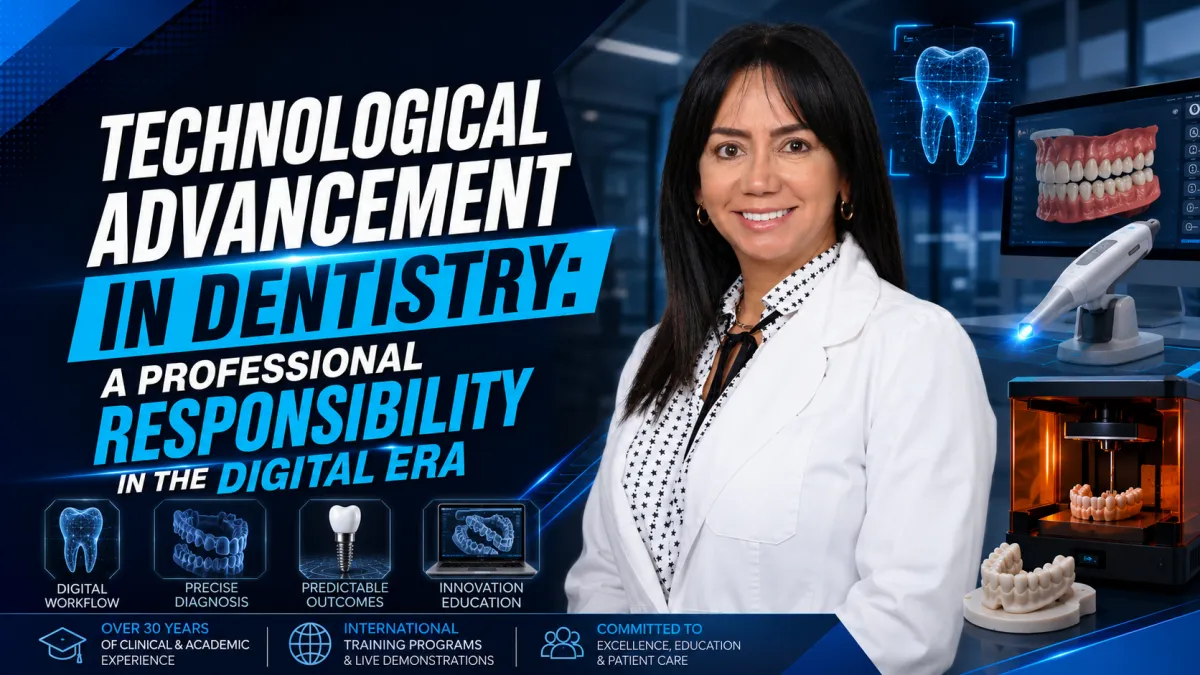
Technological Advancement in Dentistry: A Professional Responsibility in the Digital Era
By: Dr. Libia R. Ríos, DDS
Founder & Program Director, Global Dental Institute (GDI)
Abstract
Dentistry is undergoing one of the most significant transformations in its history. The integration of digital technologies, artificial intelligence, three-dimensional diagnostics, 3D printing, and fully digital workflows has fundamentally changed the way dental professionals diagnose, plan, and deliver treatment. In this evolving landscape, staying current with technological advancements is no longer merely a competitive advantage—it is an ethical and professional responsibility. This article explores the importance of continuing education and technological adoption, as well as the clinical, economic, and professional risks associated with failing to remain up to date.
Introduction
For much of the twentieth century, dentistry evolved at a relatively steady pace. Over the last two decades, however, technological growth has accelerated dramatically. Innovations that once took years to become mainstream now emerge within months.
Today, dental professionals have access to intraoral scanners capable of capturing thousands of images per second, CAD/CAM systems that fabricate highly precise restorations, cone beam computed tomography (CBCT), 3D printing technologies, virtual implant planning software, and artificial intelligence tools that assist in diagnostic analysis.
This reality raises an important question:
Can a clinician continue to provide excellence in patient care without remaining technologically current?
The answer is becoming increasingly clear. Continuous professional development and technological literacy have become fundamental pillars in ensuring safe, predictable, and evidence-based patient care.
Technology as a Tool to Enhance Patient Care
It is important to recognize that technology does not replace the clinician. Clinical judgment, experience, and diagnostic expertise remain irreplaceable.
However, technology significantly enhances a dentist’s ability to make informed decisions and deliver superior outcomes.
Traditional two-dimensional radiography, for example, remains valuable in many clinical situations. Yet CBCT imaging provides three-dimensional visualization of anatomical structures, reducing uncertainty and improving diagnostic accuracy.
Similarly, intraoral scanners have improved patient comfort and digital accuracy, while CAD/CAM systems allow clinicians and laboratories to design and fabricate restorations with exceptional precision and reproducibility.
Technology has also transformed patient communication. Digital Smile Design, virtual simulations, and advanced clinical photography help patients better understand their treatment options and increase acceptance of proposed treatment plans.
In essence, technology enables a more precise, efficient, and patient-centered approach to dentistry.
The Risks of Failing to Stay Current
Despite the clear advantages of technological advancements, some professionals continue to view technology as optional rather than essential. This mindset can expose both clinicians and patients to significant risks.
1. Clinical Risk
A lack of technological awareness can limit diagnostic capabilities and treatment planning.
When tools exist that allow earlier detection of disease, more accurate diagnoses, or more predictable outcomes, failing to understand or utilize them may increase the likelihood of errors, complications, and less favorable treatment results.
The goal is not to depend on technology but to use it as an extension of clinical judgment to reduce uncertainty and improve quality of care.
2. Professional Obsolescence Risk
Modern dentistry demands lifelong learning.
The knowledge acquired during dental school provides the foundation for practice, but it is not sufficient to meet the challenges of an entire professional career.
Clinicians who stop learning risk falling behind colleagues who continually adopt new protocols, techniques, and technologies.
In an environment where innovation advances rapidly, professional obsolescence can occur sooner than many practitioners realize.
3. Competitive Risk
Today’s patients are more informed than ever before.
They research providers, compare treatment options, and frequently seek practices that offer advanced technology and modern solutions.
Terms such as digital dentistry, intraoral scanning, Digital Smile Design, 3D printing, and artificial intelligence have become increasingly familiar to patients.
A practice that fails to evolve may be perceived as outdated or less capable of delivering advanced care.
Innovation inspires confidence, strengthens professional credibility, and enhances the overall patient experience.
4. Economic Risk
Technology has a direct impact on the financial performance of a dental practice.
Manual workflows, repeated adjustments, remakes, and inefficiencies often increase operational costs and reduce productivity.
Conversely, properly integrated digital technologies streamline workflows, improve efficiency, reduce treatment time, and optimize resource utilization.
Perhaps most importantly, enhanced patient communication frequently leads to greater case acceptance and increased treatment value.
5. Legal and Professional Liability Risk
Standards of care continue to evolve.
While not every new technology immediately becomes a requirement for practice, there is a growing expectation that clinicians remain knowledgeable about available tools and understand their indications, benefits, and limitations.
In legal reviews or professional evaluations, continuing education and current knowledge may help demonstrate that clinical decisions were made according to contemporary standards of care.
Artificial Intelligence: The Next Major Transformation
Artificial Intelligence may represent the most disruptive innovation in dentistry since the adoption of digital radiography.
AI systems are already being used to assist in the detection of caries, periodontal disease, periapical pathology, and radiographic abnormalities. Additionally, AI is beginning to influence treatment planning, administrative management, patient communication, and data-driven decision-making.
Dental professionals who understand and embrace these technologies will be positioned to improve efficiency, enhance diagnostics, and elevate patient care.
Those who choose to ignore these developments risk facing an increasingly significant technological gap.
Conclusion
Clinical excellence requires far more than accumulated experience. It requires a commitment to lifelong learning.
Remaining technologically current does not mean purchasing every new device that enters the marketplace. Rather, it means understanding the evolution of the profession, critically evaluating emerging innovations, and adopting those that provide meaningful benefits to patients.
Technology will continue to advance. The question is not whether dentistry will change, but whether we are prepared to lead that change.
Professionals who invest in continuing education, innovation, and technological advancement will not only safeguard the future of their practices but will also contribute to raising the standards of care throughout the profession.
The future of dentistry is no longer a distant vision. It is happening now. Those who commit to staying current will be the ones who lead the next generation of dentistry.
References
American Dental Association (ADA). Digital Dentistry: Clinical Applications and Future Directions. Chicago, IL.
Coachman C., Calamita M. Digital Smile Design: A Tool for Treatment Planning and Communication. Quintessence Publishing.
Mangano F., et al. “Intraoral Scanners in Dentistry: A Review of the Current Literature.” BMC Oral Health.
Patel S., et al. “Cone Beam Computed Tomography in Endodontics and Implant Dentistry.” International Endodontic Journal.
Schwendicke F., et al. “Artificial Intelligence in Dentistry: Opportunities and Challenges.” Journal of Dental Research.
Dawood A., Marti B., Sauret-Jackson V., Darwood A. “3D Printing in Dentistry.” British Dental Journal.
FDI World Dental Federation. Vision 2030: Delivering Optimal Oral Health for All.